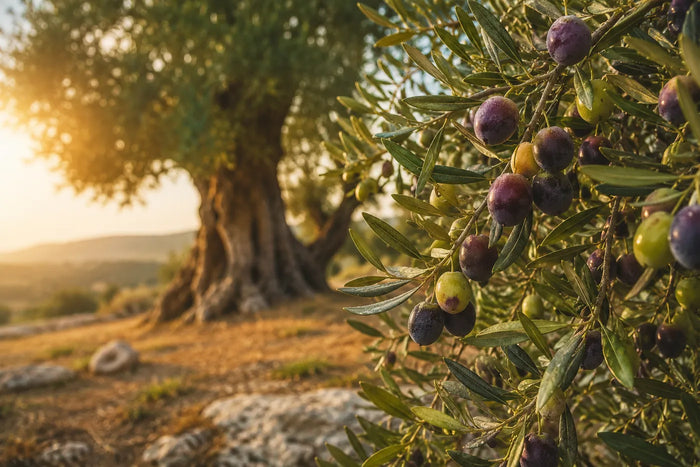
Somewhere in the Mediterranean this month, someone is standing in a grove deciding whether to start. The olives are still green, or just turning. Wait three weeks and there will be noticeably more oil in them. Start now and there will be less of it, but it will taste like something else entirely.
That decision — not the variety, not the region, not the label design — is most of the difference between two bottles of extra virgin olive oil.
The same tree, six weeks apart
An olive doesn't ripen the way an apple does. It accumulates oil as it goes from green to purple to black, and it loses something else on the way. Pick early and the fruit is hard, green and stubborn. Pick late and it is soft, oily and generous.
Both can produce extra virgin olive oil. Both are legitimate. They are simply different products from the same tree, and the grower chooses which one to make.
Why early-harvest oil costs more
Here is the number that explains the price tag, and it is bigger than most people expect.
Green olives run at roughly 8 to 12% oil by weight. Fully ripe olives can reach 20 to 25%. In practical terms, a litre of early-harvest oil takes two to three times as many olives as a litre pressed from ripe fruit.
The mill feels it too. Green fruit is harder and more fibrous, so it takes more energy to crush and longer to separate. Same grove, same labour, same machinery — and less than half the oil at the end of the day.
That is the whole economics of it. Nobody picks early by accident.
What it tastes like
The International Olive Council has official vocabulary for this, and it is worth knowing because it appears on labels. Green fruitiness describes an oil reminiscent of green fruit, from green, sound, fresh olives. Ripe fruitiness is the same idea at the other end of the season.
Early-harvest oils lean green: grass, artichoke, green tomato, green almond, with more bitterness and more of that peppery catch in the throat. Late-harvest oils lean soft, golden and buttery, sometimes faintly sweet, with the bitterness and pungency turned right down.
The IOC's own definition of pungency gives the game away. It describes the sensation as "characteristic of oils produced at the start of the crop year, primarily from olives that are still unripe." The sting is not a fault and it is not a coincidence — it is a timestamp.
Which style is better depends entirely on what you are doing. A green, bitter oil over grilled vegetables or a bowl of beans is the point of the thing. The same oil on a delicate fish can bulldoze it.
The polyphenol part, handled carefully
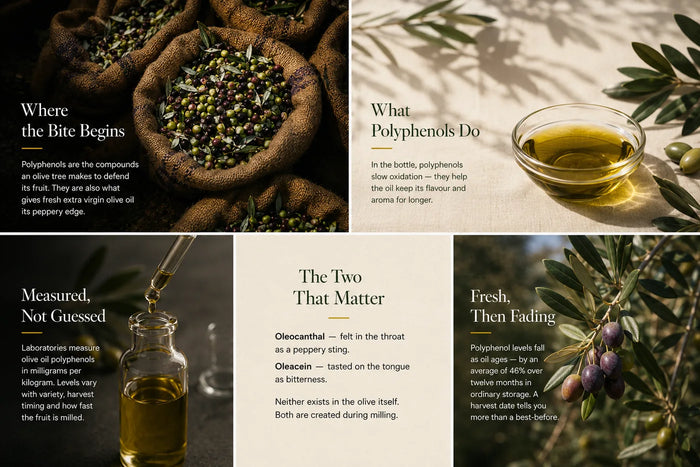
Polyphenols are the compounds behind that bitterness and pungency, and they are consistently higher in oil made from earlier, greener fruit. That much is well established and easy to measure.
What is harder is the leap people make next. In the European Union, a specific health claim about olive oil polyphenols and blood lipids is permitted where an oil provides at least 5 mg of hydroxytyrosol and its derivatives per 20 g. That is a European regulatory position, not an approved health claim in Australia, where nutrition and health claims fall under FSANZ Standard 1.2.7. EFSA also declined a separate application on cholesterol and blood pressure in May 2025.
Worth knowing as context.
The other half of the story is that polyphenols fall over time in every oil, whatever month it was picked. In one study following oils through ordinary storage, phenolic content dropped by an average of 46% over twelve months. An early-harvest oil simply starts higher on the same downward slope.
Two hemispheres, two calendars
This is where Australian shoppers get caught out.
In Spain, Italy and Greece, harvest runs roughly October to January. In Australia it falls around April to June. So a bottle labelled "new season" in an Australian aisle in November might be six weeks old or ten months old, depending on which hemisphere it came from — and nothing on the front of the bottle distinguishes the two.
The harvest date does. The best-before date does not: it is usually calculated from bottling, and oil can sit in a tank for months before it reaches a bottle.
"Early harvest" is not a legal term
This part matters. Extra virgin is a legally defined grade with laboratory limits and a sensory panel behind it. Early harvest is not. There is no threshold, no certifying body and no test that separates an early-harvest oil from one picked a fortnight later.
It is a genuine and useful description — and an unpoliced one. So treat it as a claim to verify rather than a guarantee, and verify it the same way you'd verify anything else on an olive oil label:
- A printed harvest date, not only a best-before
- The variety named
- Dark glass or tin
- And, if you can, taste it — bitterness and pungency are the honest signal
Common questions
Is early-harvest olive oil better than regular olive oil?
Not better, different. Early-harvest oils are greener, more bitter and more pungent, and they cost more because the same quantity of fruit yields far less oil. Late-harvest oils are milder and rounder. The right choice depends on the dish and on your palate.
Why is early-harvest olive oil so expensive?
Because green olives contain roughly half the oil of ripe ones. A litre of early-harvest oil can take two to three times as many olives, and green fruit is also slower and more energy-intensive to mill.
When is olive oil harvested?
In the northern hemisphere, roughly October to January, with early-harvest picking at the start of that window. In Australia, harvest runs around April to June. This is why "new season" means different things depending on where the oil came from.
Does early-harvest olive oil stay fresh longer?
It starts with more polyphenols, but it declines on the same curve as any other oil once bottled. Storage does more than harvest timing here: keep it cool, dark and closed, and use it rather than saving it.
If you want the other half of this story — what that peppery sting actually is and why it isn't in the olive — we wrote about it in Why Good Olive Oil Burns Your Throat. The harvest window is one of the decisions we are working through right now, and we write about them as they happen in the Journal.
This article is for general information only. It is not medical or dietary advice, and it is not a claim about any specific product. For personal health or skin advice, speak with a qualified professional.
By Poveda Olea Team · Last updated