In Mediterranean kitchens there were often two jugs: a big one for cooking, and a smaller one that never went near the stove. That second jug was for hands cracked by winter, for hair, for a child's dry elbows. People have rubbed olive oil on their skin for centuries, and your grandmother probably swore by it.
But does it actually do anything, or is it just a nice old habit? Here's the honest version.
What's in olive oil that your skin likes
Olive oil is more than just lipids. It carries a few compounds skin genuinely gets on with:
- Squalane — a light oil closely related to something your own skin already makes. It sinks in without feeling greasy.
- Vitamin E (tocopherol) — a compound that helps protect the oil itself from going rancid.
- Polyphenols such as hydroxytyrosol — the same family of compounds studied in extra virgin olive oil as a food.
It softens skin and slows water loss
This is the part that is well established. Olive oil is an emollient — a substance that softens the skin's surface and helps it hold on to water. Think of a light blanket that slows moisture escaping. It is why skin usually feels smoother and more comfortable afterwards, and it is the oldest reason anyone reached for that second jug.
Why the bottle in your pantry isn't skincare
Here is a story most people don't know. For most of the twentieth century, the squalane in the world's moisturisers came from sharks — specifically from the liver oil of deep-sea species, harvested at a scale that became impossible to defend. The cosmetics industry needed a plant that produced the same molecule in useful quantity, and the olive turned out to be one of the very few that does. A great deal of the squalane on shelves today began as Mediterranean olives.
That switch is the whole difference in miniature. The squalane in a serum is olive-derived, isolated, purified and stabilised. The squalane in your cooking oil is there too — in traces, alongside everything else the fruit brought with it.
And "everything else" is the catch. Culinary extra virgin olive oil is unrefined by definition: it carries chlorophyll, waxes, plant fragments and free fatty acids, all of which are glorious on warm bread and less welcome on a face. Olive oil also sits mid-range on the comedogenic scale, meaning it is more inclined than lighter oils to linger in pores.
None of which makes the old habit wrong. That second jug softened a lot of hands for a lot of centuries, and it still will. But it is worth knowing what you are choosing: the whole fruit, or one molecule from it, prepared to do a single job precisely. Patch test on your forearm either way, and skip olive altogether if you are allergic to olives.
How to read a label
Look for squalane, tocopherol (vitamin E) or Olea europaea, which is simply the botanical name for the olive. Certification marks such as COSMOS ORGANIC tell you about how the ingredients were grown and processed, not about how well the product will work.
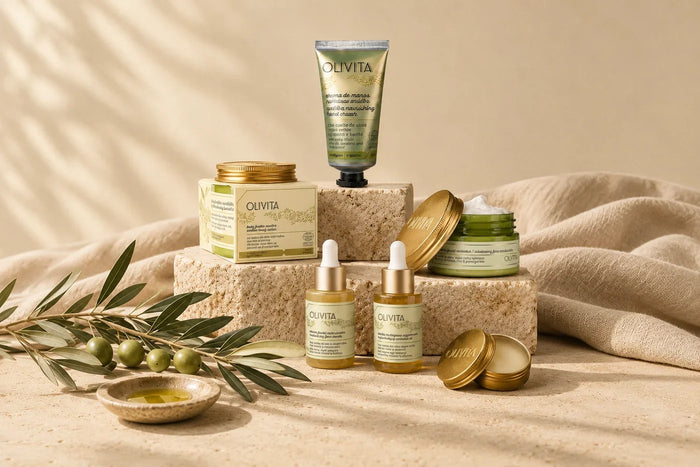
Olivita, the olive skincare range selected by Poveda Olea, is made on exactly that idea: olive-derived ingredients formulated for skin, rather than the bottle from the pantry. Each product in the Olivita range lists its full ingredients, so you can read the label for yourself.
Common questions
Can you put olive oil straight on your face?
You can, and people have for centuries, but it is not always the best choice. Culinary olive oil is formulated for eating, not for skin, and on sensitive or acne-prone skin it can feel heavy. Patch test first.
Is squalane the same as squalene?
They are closely related but not identical. Squalene is the unstable form; squalane is the hydrogenated, shelf-stable version used in skincare. Olive is one of the main plant sources, and a common alternative to shark-derived squalene.
Does olive oil clog pores?
It depends on the skin. Olive oil is moderately comedogenic, meaning it is more likely than a very light oil to sit in pores. If you are prone to congestion, a formulated product using isolated olive-derived ingredients is usually a better bet than the bottle in your pantry.
The bottom line: olive oil isn't a miracle in a bottle, but it is a genuinely good, time-tested ingredient for softer, more comfortable skin. Some old habits stick around because they work.
This article is for general information only. It is not medical or dietary advice, and it is not a claim about any specific product. For personal health or skin advice, speak with a qualified professional.
By Poveda Olea Team · Last updated