Pour a little extra virgin olive oil into a spoon and taste it on its own. If it catches at the back of your throat — a peppery grip, sometimes sharp enough to make you cough — that is not a fault. It is the most useful thing a bottle of olive oil can tell you about itself.
The sting has a name
That peppery catch comes from a compound called oleocanthal, and it behaves unlike most flavours. Nearly everything else you taste is sensed on the tongue. Oleocanthal is barely detectable there. It acts almost entirely on the throat, which is why the sensation arrives a second late and lands somewhere you don't normally taste anything at all.
Bitterness works differently again — that one is on the tongue, and it comes mostly from a related compound, oleacein. Together these two belong to the polyphenols, the compounds a plant makes to defend itself, and they are what researchers have spent the past two decades studying most closely.
It isn't in the olive
Here is the part that surprises most people. Oleocanthal doesn't exist in the fruit. It isn't in the leaf either. It is created in the mill, in the moment of crushing, when enzymes finally meet the molecules they act on.
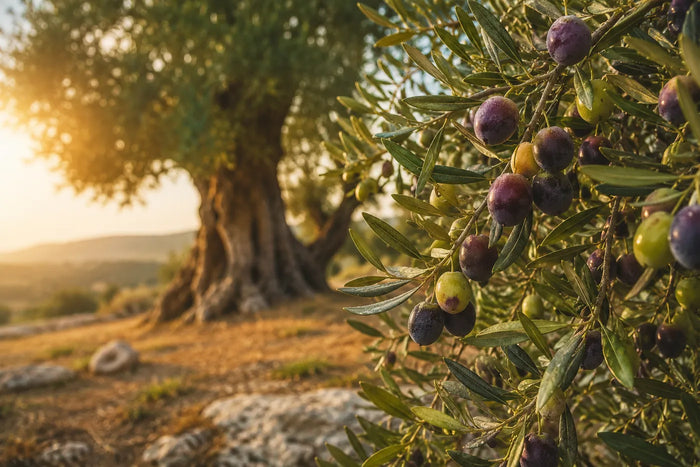
Which means the peppery bite in your kitchen was made in a specific few minutes, on a specific morning, by someone watching the paste and deciding it was time. Millers in Spain have been reading that moment every autumn for a very long time.
That single fact explains a great deal. It explains why the sting is strongest in oil pressed from fruit picked early and milled fast. It explains why refined oils — those sold as "pure", "classic" or "light" — have none of it, since refining strips these compounds out. And it explains why extra virgin is the only grade where any of this applies.
Where your oil probably comes from
Spain produces close to 40% of the world's olive oil — around 1.37 million tonnes of a global 3.4 million in the current season, more than the next several countries combined. If you buy olive oil in Australia, the odds are good that it began in an Andalusian grove.
Which makes the Spanish varieties worth knowing, because they don't taste alike. Picual and Cornicabra are the robust ones — green, assertive, and the most likely to make you cough. Arbequina and Hojiblanca are softer and rounder, gentler on the throat. Neither style is better. But if you have been buying mild oil and wondering what all the fuss about pungency is, you have simply been buying the other kind.
It fades
The one number worth remembering: in a study tracking oils through ordinary storage, phenolic content fell by an average of 46% over twelve months.
Extra virgin olive oil is a fruit juice. It does not improve with keeping. The peppery oil you loved in autumn will be noticeably quieter by the following spring — and quieter still if it has spent that time in clear glass beside the stove.
What to do about it
Look for a harvest date rather than only a best-before, and prefer a recent one. Choose dark glass or a tin. Keep it in a cupboard, away from the cooktop, with the cap on. And use it — the most common mistake is treating a good bottle as too precious for a Tuesday.
Then taste it on a spoon now and again. Your throat will tell you how the oil is doing long before the date on the label does.
This spoonful is more or less the whole reason Poveda Olea exists. We are choosing the oils now and writing about how the decision gets made — that happens in The Olive Tree Journal.
Common questions
Why does olive oil burn my throat?
Because of oleocanthal, a natural compound formed when olives are crushed. It acts on the throat rather than the tongue, producing a peppery sting that can make you cough. It is a sign of a fresh, unrefined extra virgin olive oil, not a defect.
Is bitter olive oil bad?
No. Bitterness and pungency are recognised positive attributes in extra virgin olive oil, and official tasting panels score them as such. Both tend to be strongest in oil made from early-harvest fruit.
How long does extra virgin olive oil last once opened?
Flavour and phenolic content decline steadily from the day it is milled. As a working rule, use it within a few months of opening and within about a year of harvest, stored cool, dark and closed.
Does olive oil that doesn't sting mean it's low quality?
Not necessarily. Mild varieties such as Arbequina are naturally gentler. But an oil with no bitterness or pungency at all is usually either an older oil, a riper harvest, or a refined grade.
If you are curious about what these same compounds do outside the kitchen, we looked at that in Olive Oil for Your Skin.
This article is for general information only. It is not medical or dietary advice, and it is not a claim about any specific product. For personal health or skin advice, speak with a qualified professional.
By Poveda Olea Team · Last updated