The simplest thing on a Mediterranean table is usually the hardest to improve: good bread, good anchovies, good extra virgin olive oil. Nothing is cooked. Nothing is hidden. Which is exactly why each of the three has to be worth eating on its own.
Northern Spain · Serves 4 · 5 minutes · Very easy
Ingredients
- 12 best-quality anchovy fillets in oil
- Thin slices of rustic bread, lightly toasted
- 1 garlic clove (optional)
- Flaky sea salt
- Extra virgin olive oil, for finishing
Method
- Lightly toast the bread and rub it with the garlic clove if you like.
- Lay two or three anchovy fillets over each slice.
- Drizzle generously with extra virgin olive oil.
- Finish with a few flakes of sea salt and serve straight away.
The point of the dish
The raw oil softens the anchovy and lifts it — pour without fear. Anchovies are cured in salt, so they arrive intense; the oil is what rounds that edge and carries the flavour across the bread. Use it as a finishing oil, never heated, and use more of it than feels reasonable.
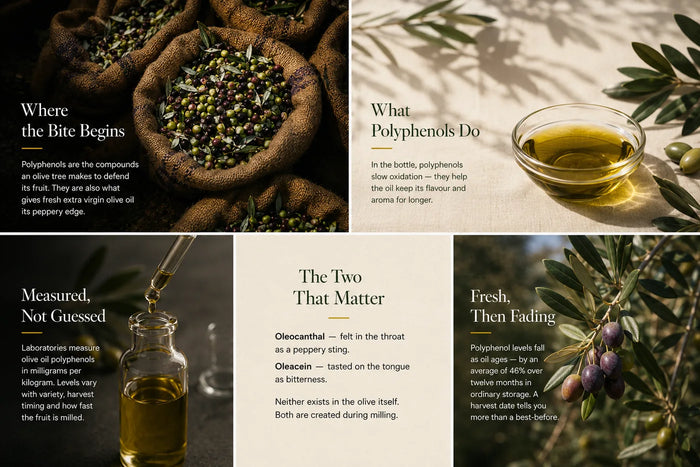
A peppery, early-harvest oil works especially well here, because the bite holds its own against the salt. If you want to know where that pepperiness comes from, we wrote about it in Why Good Olive Oil Burns Your Throat.
Why the anchovies come from Santoña
If a dish has three ingredients, it is worth knowing where one of them comes from. These are anchoas del Cantábrico — anchovy caught in the Bay of Biscay and cured on the Cantabrian coast, in Santoña above all, with Laredo and Colindres around the same bay.
They were not always prized. For a long time the local fleet treated the anchovy as bait. What changed was an arrival. In the 1880s and 1890s Italian salters — acciugai from Campania and Sicily, where anchovies had been cured for centuries — came north looking for new fishing grounds. One of them, the Sicilian Giovanni Vella Scaliota, settled in Santoña in 1883 and worked out how to sell the fish as ready-to-eat fillets packed in oil. The technique was Italian, the fish and the town were Spanish, and the result became Santoña's.
The method has barely changed since. The anchovy is caught close to shore in spring, at its peak. It is beheaded, gutted and layered with salt in barrels, then left under pressure for the better part of a year — eleven or twelve months is normal — while the salt draws out the water and the flesh firms and darkens.
Then comes the part no machine has taken over. Each anchovy is washed, opened and filleted by hand: skin off, bones out, the fillet trimmed and laid in oil. In Santoña's busiest decades hundreds of women did this work, the skill passed from mother to daughter, and it is still what separates a good tin from an ordinary one. It is also most of what you are paying for.
One practical note: because they are cured rather than sterilised, these are a semi-preserve, not a conserve. Keep them in the fridge.
From The Raw Mediterranean, the Poveda Olea recipe collection — published here one recipe at a time.
By Poveda Olea Team · Last updated